/tmp/bucket

A place to dump my thoughts

0%

除草,單純想在這裡 dump 一些想法。

#1

安排班夫行程。火車臥鋪肖貴。還在觀望機票和行程,希望不要售罄

#2

這週處理 3 個任務

Batch convert studiolib data

  • 寫了測試棒棒,之後改動更安心
  • 之後思考有沒有更好的方法,能跟 Maya 解耦
  • integrate with G-drive or other storages

Convert global translation to other controller

  • replace root-hip with global-main
    做功能時,之前寫的測試有幫助到找到忘記一起改的錯誤

Fixed 2 bugs

  • file format reading
  • API response updated
    覺得之前設計的架構讓我很好 debug,修改起來很快

#3

思緒上有點喘不過氣,聽說是職業倦怠的徵兆…
なんか、頭をリセットする方法ないかな。

Strategies

Memoization (Top-down)

  1. make it works first
    1. draw the tree
    2. implement & test if the answer is correct (when small cases)
  2. then make it efficient
    1. add a memo with base case return values
    2. store new values in the memo

Tabulation (Bottom-up)

  1. create a table based on the input
  2. fill it with default & base-case values
  3. iterate through to generate the next value based on the current value

What is a tier?

both logical and physical separation of components

Single-tier App

All components are located in the same machine. e.g. Maya, Photoshop…

Pros

  • no network latency
  • privacy data safe since no need to upload users’ data

Cons

  • efficiency bounds on the machine where the app lives on
  • app publisher has no control over the app (users decide whether update the app or not)
  • be vulnerable to being tweaked and reversed engineered

Two-tier App

client-server architecture

Three-tier App

client-backend-database. e.g. blog

N-tier App

What are these components?

  • cache
  • load balancer
  • database
  • queue (for asynchronous behavior)
  • search engine
  • customized business logic services

It is an implementation of the single-responsibility principle

decoupled. it’s easier to maintain. so, for example, we should not store business logic in the database. Also, it is easier to be scaled.

Layer & Tier

layers represent the conceptual/logical organization of the code (code level)

tiers represent the physical separation of components.

Quick sorting is a pre-order traversal operation. Every time we dive into a node, we divide it into two portions: small and large. Then recursively apply this logic to these two portions.

Implementation

Let’s compare the two implementations below. The first one is straightforward, and the other one uses struct.
#1

1
2
3
4
5
6
7
8
9
10
11
12
13
14
15
16
17
18
19
20
21
22
23
24
25
26
27
28
29
30
31
32
33
34
35
func quicksort(array []int) []int {
var dfs func(start, end int)
dfs = func(start, end int) {
if start >= end || start < 0 || end >= len(array) {
return
}
pivot := (start + end) / 2
swap(array, pivot, end) // swap value
pivot = end
l, r := start, end-1
for {
for ; l < r && array[l] <= array[pivot]; l++ {
}
for ; l < r && array[r] >= array[pivot]; r-- {
}
if l == r {
break
}
swap(array, l, r)
}
meet := l
if array[meet] >= array[pivot] {
swap(array, meet, pivot)
pivot = meet
}
dfs(start, pivot-1)
dfs(pivot+1, end)
}
dfs(0, len(array)-1)
return array
}

func swap(arr []int, a, b int) {
arr[a], arr[b] = arr[b], arr[a]
}

#2

1
2
3
4
5
6
7
8
9
10
11
12
13
14
15
16
17
18
19
20
21
22
23
24
25
26
27
28
29
30
31
32
33
34
35
36
37
38
39
40
41
42
type Partition struct {
Pivot int
Left []int
Right []int
}

func doPartition(array []int) Partition {
start, end, pivot := 0, len(array)-1, (len(array)-1)/2
swap(array, pivot, end) // swap value
pivot = end
l, r := start, end-1
for {
for ; l != r && array[l] <= array[pivot]; l++ {
}
for ; l != r && array[r] >= array[pivot]; r-- {
}
if l == r {
break
}
swap(array, l, r)
}
meet := l
if array[meet] >= array[pivot] {
swap(array, pivot, meet)
pivot = meet
}
return Partition{pivot, array[:pivot], array[pivot+1:]}
}

func swap(array []int, a, b int) {
array[a], array[b] = array[b], array[a]
}

func quicksort(array []int) []int {
if len(array) <= 1 {
return array
}
p := doPartition(array)
quicksort(p.Left)
quicksort(p.Right)
return array
}

Purpose of this data structure

can search words by prefix in time complexity, O(n).

Recursion Implement

1
2
3
4
5
6
7
8
9
10
11
12
13
14
15
16
17
18
19
20
21
22
23
24
25
26
27
28
29
30
31
32
33
34
35
36
37
38
39
40
41
42
43
44
45
46
47
48
49
50
51
52
53
54
55
56
57
58
59
60
61
62
63
64
65
66
67
68
69
70
71
72
73
74
75
76
77
78
79
80
81
82
83
84
85
package main

import (
"fmt"
)

type Node struct {
Keys map[string]*Node
IsEnd bool
}

func newNode() *Node {
return &Node{make(map[string]*Node), false}
}

type Trie struct {
Root *Node
}

func newTrie() *Trie {
return &Trie{newNode()}
}

func (t *Trie) Add(str string) {
Add(str, t.Root)
}

func Add(str string, node *Node) {
if len(str) == 0 {
node.IsEnd = true
return
} else if _, ok := node.Keys[str[:1]]; ok {
Add(str[1:], node.Keys[str[:1]])
} else {
// create new node for this string
node.Keys[str[:1]] = newNode()
Add(str[1:], node.Keys[str[:1]])
}
}

func (t *Trie) HasWord(str string) bool {
return HasWord(str, t.Root)
}

func HasWord(str string, node *Node) bool {
if node.IsEnd && len(str) == 0 {
return true
} else if len(str) == 0 {
return false
}
if _, ok := node.Keys[str[:1]]; ok {
return HasWord(str[1:], node.Keys[str[:1]])
} else {
return false
}
}

func (t *Trie) Words() []string {
words := []string{}
Print("", t.Root, &words)
return words
}

func Print(curr string, node *Node, words *[]string) {
if node.IsEnd {
*words = append(*words, curr)
}
for key := range node.Keys {
Print(curr+key, node.Keys[key], words)
}
}

func main() {
t := newTrie()
t.Add("apple")
t.Add("cat")
t.Add("category")
t.Add("")
fmt.Println(t.Words())
fmt.Println(t.HasWord("apple"))
fmt.Println(t.HasWord("none"))
fmt.Println(t.HasWord("category"))
fmt.Println(t.HasWord("cat"))
fmt.Println(t.HasWord(""))
}

output

1
2
3
4
5
6
[ apple cat category]
true
false
true
true
true

Forloop Implement

1
2
3
4
5
6
7
8
9
10
11
12
13
14
15
16
17
18
19
20
21
22
23
24
25
26
27
28
29
30
31
32
33
34
35
36
37
38
39
40
41
42
43
44
45
46
47
48
49
50
51
52
53
type TrieNode struct {
Children [26]*TrieNode
IsEnd bool
}

type Trie struct {
Root *TrieNode
}


func Constructor() Trie {
return Trie{&TrieNode{}}
}


func (this *Trie) Insert(word string) {
curr := this.Root
for i := range word {
// check if has word[i] as a child
k := word[i] - 'a'
if curr.Children[k] == nil {
curr.Children[k] = &TrieNode{}
}
curr = curr.Children[k]
}
curr.IsEnd = true
}

func (this *Trie) Search(word string) bool {
curr := this.Root
for i := range word {
// check if has word[i] as a child
k := word[i] - 'a'
if curr.Children[k] == nil {
return false
}
curr = curr.Children[k]
}
return curr.IsEnd
}

func (this *Trie) StartsWith(word string) bool {
curr := this.Root
for i := range word {
// check if has word[i] as a child
k := word[i] - 'a'
if curr.Children[k] == nil {
return false
}
curr = curr.Children[k]
}
return true
}

Slice or Array?

In Go, array can only be created by constant int

1
2
3
4
arr := [4]int // works

size := 4
arr := [size]int // Not work!

Thus use slice, if we want to implement a function that create a N size matrix

Implement

straight forward

  • bad memory using, not contiguous matrix
1
2
3
4
5
6
7
8
9
10
11
12
13
14
15
16
17
func newMatrix(s int) [][]int {

m := make([][]int, s)

// Wrong!
//
// for _, row := range m {
// row = make([]int, s)
// }
//

for i, _ := range m {
m[i] = make([]int, s)
}

return m
}

method 2

  • ensure to get a contiguous matrix
1
2
3
4
5
6
7
8
9
10
11
12
13
14
15
16
17
func newMatrix(s int) [][]int {
// allocate the whole space of the matrix
spaces := make([]int, s*s)

// create an empty matrix: [[] [] []...]
m := make([][]int, s)

// assign spaces to the matrix
i, j := 0, 0
for i < s {
m[i] = spaces[j : j+s]
i++
j += s
}

return m
}

Generic

more flexiable!

1
2
3
4
5
6
7
8
9
10
11
12
13
14
15
16
17
func newMatrix[T any](s int) [][]T {
// allocate the whole space of the matrix
spaces := make([]T, s*s)

// create an empty matrix: [[] [] []...]
m := make([][]T, s)

// assign spaces to the matrix
i, j := 0, 0
for i < s {
m[i] = spaces[j : j+s]
i++
j += s
}

return m
}

Usage

1
m := newMatrix[unit](3) // [[0 0 0] [0 0 0] [0 0 0]]

Resources

Problem

Given a slice a. There are 2 sub slices. One’s length is k, the other’s is p.
These 2 sub slices are not overlaid. Find the max sum of the 2 sub slices.

Return -1 if can’t find one.

Example 1:

1
2
Input: [1,3,4,7,5,8,2,9], 3, 2
Output: 35

Example 2:

1
2
Input: [1,3,4,7,5,8], 100, 2
Output: -1

Thought

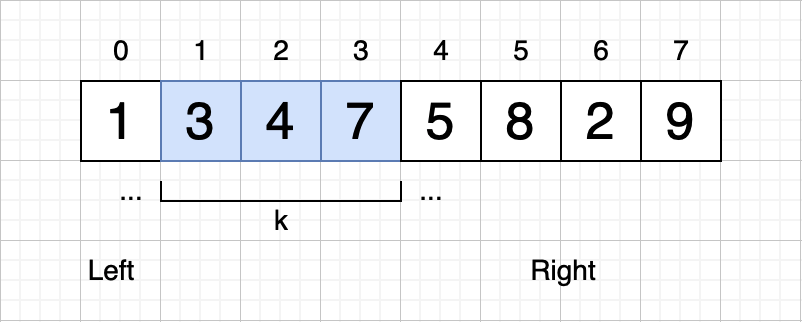
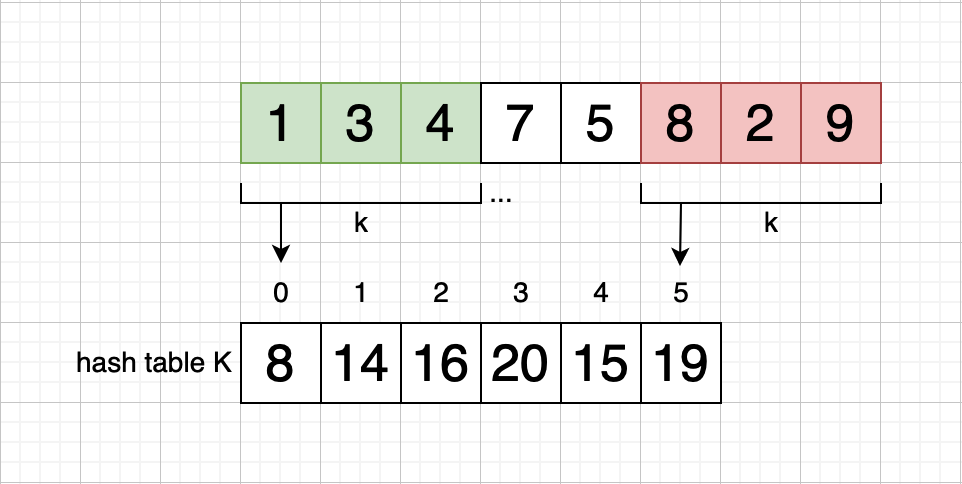
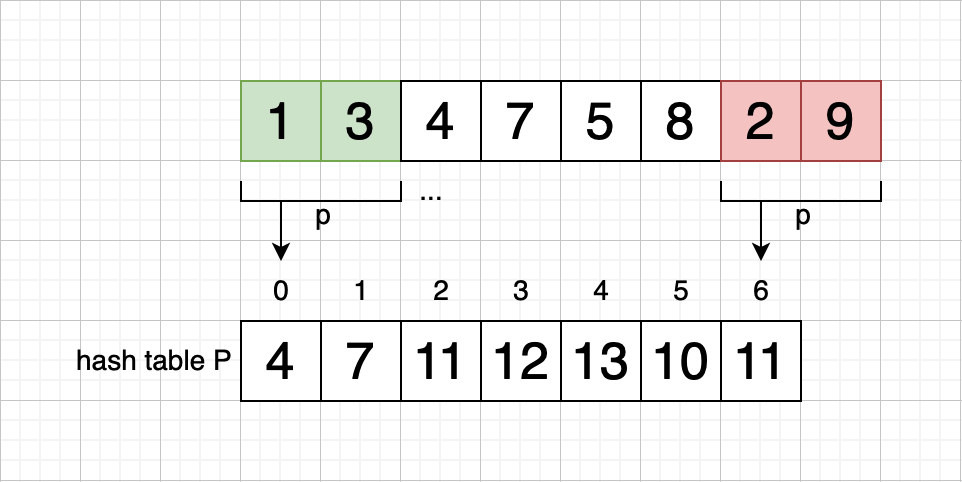
Move slice K through A, at the left and right side of K place the slice P.
To improve the efficiency, store sums of K and P in hash tables.
Code

1
2
3
4
5
6
7
8
9
10
11
12
13
14
15
16
17
18
19
20
21
22
23
24
25
26
27
28
29
30
31
32
33
34
35
36
37
38
39
40
41
42
43
44
45
46
47
48
49
50
51
52
53
54
55
56
57
58
59
60
61
62
63
64
65
66
67
68
func maxSum(a []int, k, p int) int {
if k+p > len(a) {
return -1
}
kt := hashTable(a, k)
pt := hashTable(a, p)
ki := 0
for ki < len(kt) {
left := maxVal(pt[:max(0, ki-p+1)]...)
right := maxVal(pt[min(ki+k, len(pt)):]...)

if left == -1 && right == -1 {
kt[ki] = -1
} else {
kt[ki] = kt[ki] + max(right, left)
}
ki++
}

return maxVal(kt...)
}

func hashTable(a []int, length int) []int {
if length > len(a) {
return []int{}
}
tlen := len(a) - length + 1
t := make([]int, tlen)
i := 0
for i < tlen {
t[i] = sum(a[i : i+length]...)
i++
}
return t
}

func maxVal(nums ...int) int {
m := -1
for _, v := range nums {
if m < v {
m = v
}
}
return m
}

func sum(nums ...int) int {
res := 0
for _, n := range nums {
res += n
}
return res
}

func max(i, j int) int {
if i > j {
return i
}
return j
}

func min(i, j int) int {
if i < j {
return i
}
return j
}

Problem

Given a string s, return a cropped which max length is n.
Also, spaces at prefix and postfix need to be removed.

Example 1:

1
2
Input: "Hello World", 8
Output: "Hello"

Example 2:

1
2
Input: "   Hello World   ", 100
Output: "Hello World"

Example 3:

1
2
Input: "Hello World", 3
Output: ""

Thought

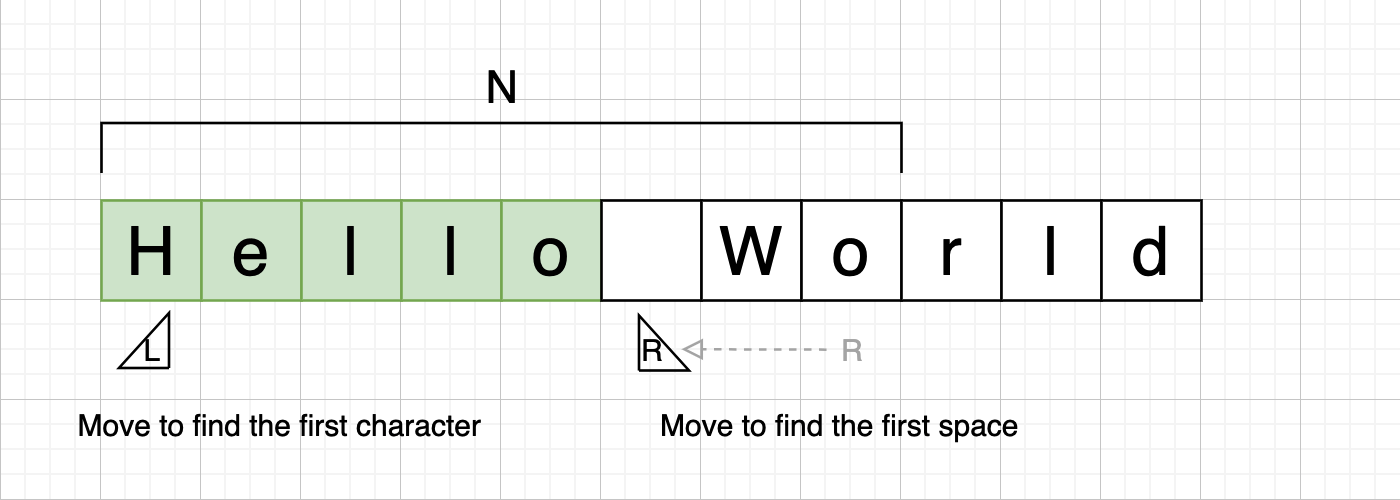
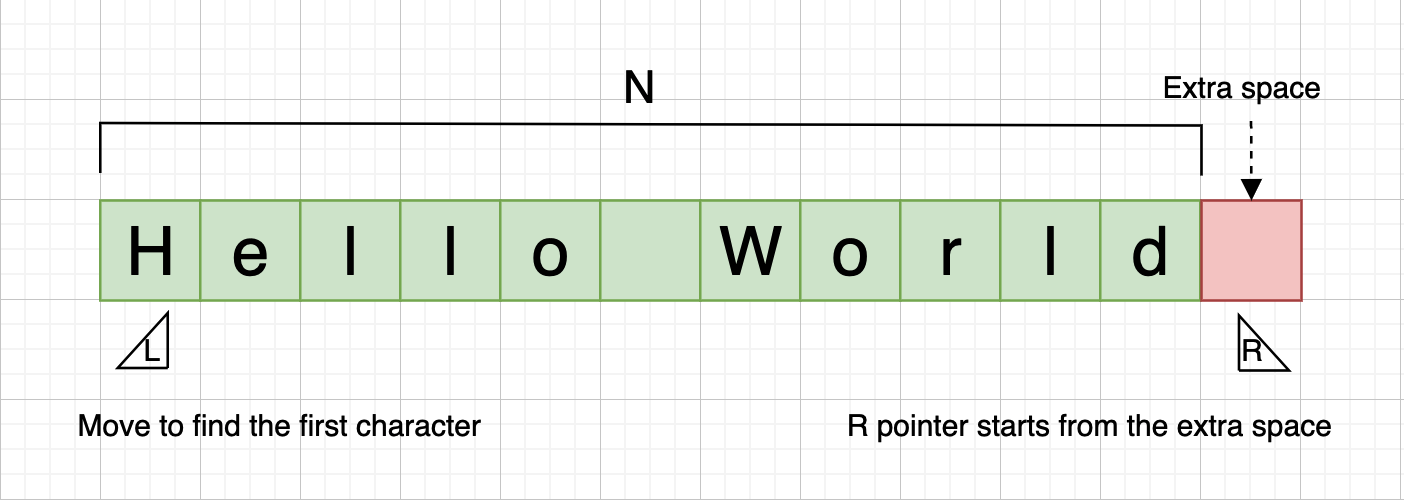
Find the start point l and end point r then return result s[l:r]
Left point is easy to find. If s[l] is space, pointer l move right.
On the other hand, r starts from l + N, if s[r] is NOT space, pointer r move left.
The tricky point is that if the given string’s length equals to given n,
and the string ends with character, the last word would be cropped.

Example:

1
2
3
Input: "Learn Golang", 12
Output: "Learn"
Expected: "Learn Golang"

An easy solution is to append a SPACE to the given string at the beginning.
Code

1
2
3
4
5
6
7
8
9
10
11
12
13
14
15
16
17
18
19
20
21
22
23
24
25
26
27
28
29
30
31
32
func crop(s string, n int) string {
s = s + " " // append an extra space

// keep moving right until reaching the first character
l := 0
for l < len(s)-1 {
if s[l] == ' ' {
l++
} else {
break
}
}

// start from `l+n` or the last char (extra space)
// keep moving left until reaching the first space
r := min(l+n, len(s)-1)
for r > l {
if s[r] == ' ' {
break
} else {
r--
}
}
return s[l:r]
}

func min(i, j int) int {
if i < j {
return i
}
return j
}

Tutorial

Follow this tutorial

New C++ Project in Xcode

Select command line tool

Edit Header Search Paths & Library Search Paths

I could not find where to edit Header Search Paths and Library Search Paths until I found this Toutube tutorial.

Set additional preferences like below

build shorcut in xCode: command + b

Resource

Concept

  • MObjects
    • class to handle all kinds of data in Maya
    • a handle object pointing to actual data
    • typeless
  • Function Sets
    • work with mobject
  • Wrappers
    • allocated and deallocated by you
  • Proxies
    • used to create custom maya objects (i.e. MPxNode, MPxDeformerNode)

Resources